Description
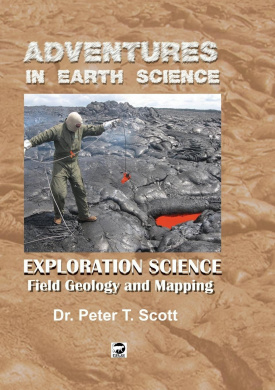
About Exploration Science Have you wondered what the science of geology is all about? Together we will explore of the surface and sub-surface of the Earth, the sub-branches of geology, including mineralogy, petrology (rocks), palaeontology (fossils), geochemistry, seismology (earthquakes), engineering geology, and many more. The scientific method used by all scientists as well as geologists, is explained, and its philosophy of investigation by observation and experimentation with deductive reasoning is outlined. You will gain an understanding of measurement and data collection the use of units of measurement, scientific notation and general application of the Metric System. Accuracy, validity and reliability of measurement and observation is also included. Practical research outdoors in the field is supported by some skill videos and the application of geological mapping, as well as research ideas. Join us in this introduction to the fascinating world on which we live! Peter Scott was born in Sydney to country people who were forced to move to the city during the Great Depression. His mother’s family came from Yass where their ancestors had settled in the town in the early days of its foundation and were mainly blacksmiths or on the land. Many of the situations and characters are loosely based on the author’s many visits to Yass as a boy. He was raised and mainly educated in Sydney and was sent out to Canberra, the Nation’s capital as his first appointment asa teacher at age nineteen. Later he returned to Sydney, married, then moved to again to the country in the north and northwest of the state of New South Wales to teach before moving his family further north to the tropical state of Queensland. During this time, he raised his family, served as an Officer in the Army Reserve, an Officer-Instructor in the Naval Cadets, sailed on tall ships on several cruises in the Tasman and Coral Seas and studied at University by part-time or distance education. Through these studies, he received firstly a Bachelor of Science degree in Geology followed by research Masters’ Degrees in Geology and Educational Administration and finally a Doctorate in Education. He retired in 2008, having been honoured as a ‘Teacher of the Year’ by the Queensland Government for his work in both teaching and in the many State and Industry committees including Head of Syllabus of Earth Science. Having travelled to all seven continents including much of his native Australia and having had many adventures in wild places such as the Antarctic Peninsula, the high Andes and Rockies of the Americans, the Amazon jungle, the European Alps and the deserts of North Africa, Dr. Scott took to writing and photography. His first eleven books were on Earth Science – Geology, Oceanography, Meteorology and Astronomy – written as textbooks for Secondary teachers and also more readable books for general use. He followed these up by a further six books on the environment. He illustrated all of these books using photographs and linked videos which he had taken during his own adventures. Later non-fiction books included easy-to-read books on teaching and self-survival in the field. He then turned to writing novels, the first being ‘Letters from San Rafael’, an historical adventure set in South America near the end of the nineteenth century. This book includes many of the local stories, culture, language and myths from his extensive travels around that continent where he also has relatives by marriage. This book was followed by a sequel of more exciting adventures and a prequel expanding one of the mysterious characters encountered in the previous work. He then used his experiences in Antarctica, his training ‘before the mast’ and his science training to write two science fiction novels: one set in Antarctica in the 1840’s and the other on board a fighting frigate during the Napoleonic Wars. As a change in genre, he then turned to humour to write a novel about the ‘coming of age’ about a young teacher, Tom Shipley, in his first appointment in a crazy school full of interesting characters. This was followed by its sequel when the young Tom Shipley, volunteers for the Army Reserve during the Vietnam War and finds himself at war with the Army’s senior officers. The next novel is a series of ‘bush’ or country tales told from the point of view of a young city boy taken to the country for Christmas with his mother’s family. These stories illustrate Australian country life in the 1950’s and are both humorous and descriptive of life in a country town.