Description
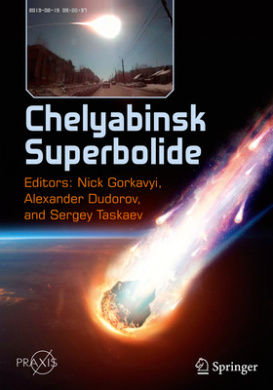
Dr. Nick Gorkavyi is a Lead Programmer/Analyst in the Science Systems and Applications, Inc. His research interests include atmospheric aerosol and space dust, remote sensing techniques and planetary science. Dr. Gorkavyi has held previous research positions with NRC/NAS-GSFC/NASA, the Crimean Astrophysical Observatory, the Schafer Corporation and QinetiQ NA. He has published a monograph and more than 100 scientific papers. Asteroid Gorkavyj 4654 is named in his honor. Prof. Alexander Dudorov is a physicist and Head of the Department of Theoretical Physics at Chelyabinsk State University. He is currently researching magnetic fields in accretion and protoplanetary disks. Asteroid Dudorov 8795 is named in his honor. Dr. Sergey Taskaev is a Doctor of Physical and Mathematical Sciences and Professor of the Condensed Matter Physics Department at Chelyabinsk State University. Acknowledgements.- Dedication.- Preface.- 1. Meteors, meteorites and the Chelyabinsk superbolide: main facts.- 2. A million observers of the superbolide.- 3. The fate of the fiery serpent.- 4. Meteorite rush: the collection of sky stones.- 5. The hunt for cosmic dust.- 6. Chebarkul meteorite ice hole.- 7. Underwater excavations and welcoming the Big Meteorite.- 8. Why the stone exploded.- 9. Chemical composition, structure and age of the Chelyabinsk bolide.- 10. Meteorology of the superbolide or super-experiment in the atmosphere.- 11. Dust ring around the Earth caused by the Chelyabinsk bolide.- 12. Basalt threads in the dust of the Chelyabinsk bolide: Pele’s hair analog.- 13. Frequency of meteorite falls.- 14. How to protect Earth from meteoroids, asteroids and comets.- 15. The cultural aftershock of the Chelyabinsk bolide.- Appendix: The lonely Moon, double asteroids, and multiple collisions.- Index.